
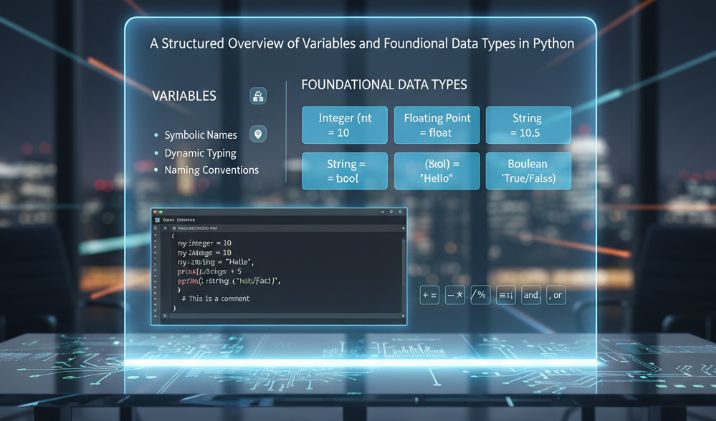
A Structured Overview of Variables and Foundational Data Types in Python
Effective data management is a cornerstone of programming. Python, renowned for its clarity and versatility, provides a set of fundamental data types and variable operations that serve as the essential building blocks for software development. This post will delineate these core concepts in a formal manner.
The Concept of Variables
A variable functions as a symbolic name, or reference, assigned to a value stored in the computer’s memory. It acts as a container for data, which can be retrieved and altered throughout a program’s execution. A defining characteristic of Python is its dynamic typing; the interpreter infers a variable’s type from the value assigned to it, eliminating the need for explicit type declaration.
Variable Naming Conventions:
- A variable name must commence with a letter or an underscore character.
- It may comprise letters, numbers, and underscores.
- It cannot begin with a numeral.
- Variable names are case-sensitive. For instance,
myVariableandmyvariableare considered distinct identifiers.
Foundational Data Types
Python incorporates several primitive data types, including:
- Integer (int): Represents whole numbers, such as
10or-5. - Floating Point (float): Represents real numbers containing a decimal point, such as
10.5or-3.14. - String (str): Represents a sequence of characters enclosed within single or double quotation marks, for example,
"Hello". - Boolean (bool): Represents one of two logical values:
TrueorFalse.
Other complex data structures like lists, tuples, and dictionaries will be addressed in subsequent discussions.
Outputting Variable Values
The print() function is utilized to display the value of a variable or expression.
my_integer = 10
my_string = "Hello"
print(my_integer)
print(my_string)
The Role of Comments
Comments are annotations within the code that are ignored by the Python interpreter. Initiated by the hash symbol (#), they are indispensable for documenting code logic, enhancing readability, and facilitating collaboration.
Fundamental Arithmetic Operations
Python supports standard arithmetic operators for numerical computations.
- Addition (
+) - Subtraction (
-) - Multiplication (
*) - Division (
/) - Modulo (
%), which yields the remainder of a division operation.
Example:
my_integer = 10
my_float = 3.0
print(my_integer + my_float)  # Result: 13.0
print(my_integer * my_float)  # Result: 30.0
print(my_integer / my_float)  # Result: 3.333...
print(my_integer % 3)         # Result: 1
Fundamental String Operations
Strings support operations such as concatenation (joining) and repetition.
my_string = "Hello"
another_string = "World"
print(my_string + " " + another_string)  # Result: Hello World
print("nom " * 3)                        # Result: nom nom nom
It is critical to note that attempting operations between incompatible types, such as adding a string to an integer, will raise a TypeError.
Comparison and Logical Operators
Python provides operators for evaluating conditions and combining logical statements.
- Comparison Operators: Equal to (
==), Not equal to (!=), Greater than (>), Less than (<), Greater than or equal to (>=), Less than or equal to (<=). - Logical Operators: Logical AND (
and), Logical OR (or), Logical NOT (not).
Example:
my_integer = 10
my_float = 20.0
print(my_integer == 10)                          # Result: True
print(my_float != 20.0)                          # Result: False
print(my_integer > 5 and my_float < 25.0)        # Result: True
print(not (my_integer > 5))                      # Result: False
Dynamic Typing in Practice
Python permits the reassignment of a variable to a value of a different data type.
my_variable = 10
my_variable = "ABC"
print(my_variable)  # Result: ABC
This characteristic exemplifies the dynamic nature of the language.