
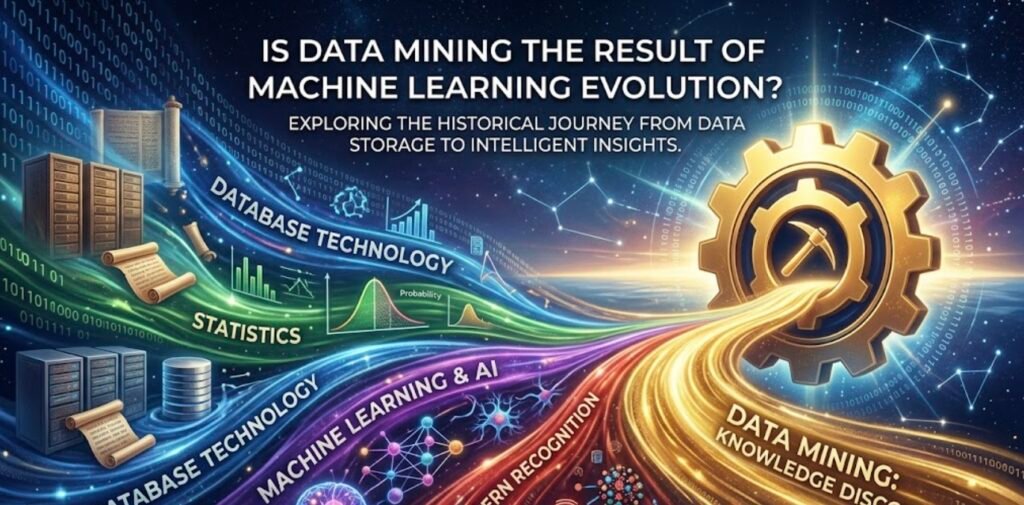
Did data mining also evolve from machine learning, statistics, and pattern recognition?
Let’s look at how these different fields came together historically to create modern data mining!
🚀 The Short Answer: Yes!
Data mining is absolutely the result of the evolution of machine learning research, along with statistics and pattern recognition.
While database technology provided the power to store and manage huge amounts of data, machine learning and other fields provided the smart algorithms to learn and find patterns from that data.
⏳ A Brief History: How 5 Fields Created Data Mining
If we look at the historical progress from the 1960s to the 1990s, we can see a beautiful integration of different technologies:
1. Database Technology (1960s–1980s) 🗄️
- Early databases focused on storing, retrieving, and managing large amounts of data efficiently.
- As databases grew massive, researchers realized that storing data was not enough. They wanted to discover useful, hidden knowledge from it.
2. Statistics (1970s–1980s) 📊
- Statistical methods were the original ways to analyze data, identify relationships, and make predictions.
- Many core data mining techniques, such as regression and probability models, directly came from traditional statistics.
3. Machine Learning and AI (1980s–1990s) 🤖
- Machine learning research developed smart algorithms that could learn patterns automatically from data.
- Crucial techniques like decision trees, neural networks, clustering, and classification became the foundational brain of data mining.
- Data mining adopted these techniques and extended them to handle very large databases and noisy, real-world data.
4. Pattern Recognition 🎯
- Pattern recognition contributed powerful methods for detecting regularities, shapes, and structures in data.
- This was especially helpful in image, speech, and signal processing.
5. Data Mining Emerges (1990s) 🌟
With the rapid explosion of digital data and data warehouses, researchers combined methods from all these separate areas. They created Data Mining as a unique discipline focused on:
- Knowledge discovery (finding real value)
- Scalable algorithms (working fast with big data)
- Large real-world datasets (handling messy data)
- Practical business applications (making smart corporate decisions)